

Why We Had to Rethink QA
At Manatal, we are delivering more changes than before. Our team has grown; we work in smaller increments, and AI-assisted development has shortened the time from idea to implementation.
But as our development speed increased, our QA process did not keep pace.
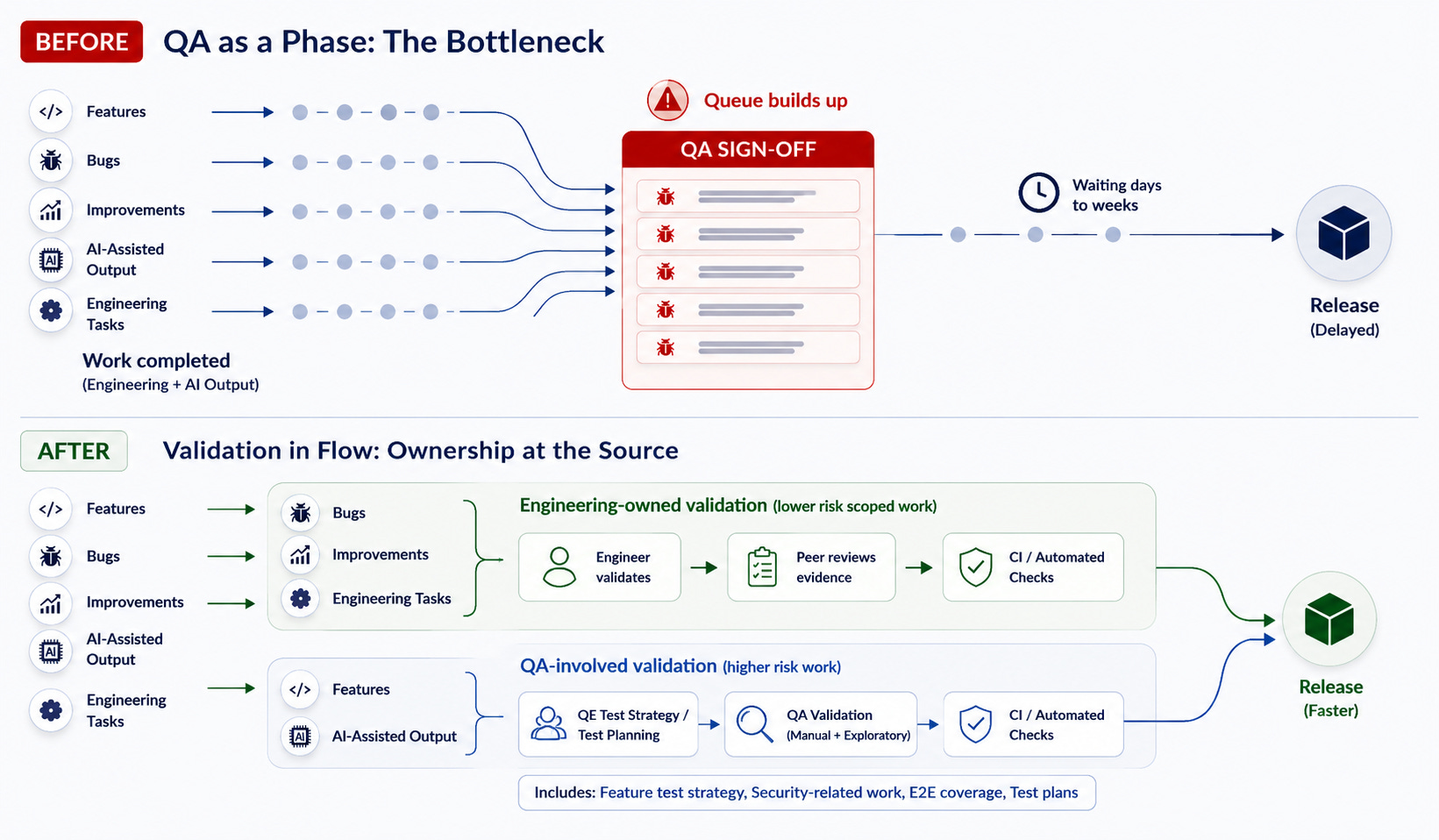
Bugs, small product improvements, and technical fixes were accumulating at the final QA step. Across three teams, it was common to have 4 to 8 completed items per team waiting for validation, often spilling into the next sprint.
Many of these changes were straightforward and could have been validated quickly by the engineers who built them. Yet they followed the same process as larger or higher-risk work.
The bottleneck came from our delivery model, which sent nearly every change through the same QA checkpoint regardless of risk.
The engineers who built lower-risk changes would validate them, and QA remained involved when deeper testing was needed.
Where the Process Slowed Down
The old process was simple. Once an engineer finished a bug fix or small improvement, the ticket moved to the QA queue. QA picked it up based on availability, tested the change manually, and approved it for release.
This worked when the organization was smaller, and the number of changes was easier to absorb. As the volume increased, the same flow began to slow delivery.
As engineering output increased, completed work began to collect in the QA queue and regularly spilled into the next sprint.
Many of these items were not complex. In many cases, the engineer who made the change had enough context to validate it quickly.
But the process treated too many different types of work in the same way. A small technical fix could follow a validation path similar to that of a large feature or a security-sensitive area. The waiting time was not always connected to risk, scope, or complexity.
The result was a slower release flow. Work kept piling up at the end, even though the validation itself was simple.
That led us to three requirements:
Lower-risk validation needed to move closer to Engineering. Simple work should not wait several days for a final QA step when it can be validated directly by the team that built it.
QA involvement needed to become risk-based. Higher-risk areas still require QA judgment, test planning, and deeper coverage, but not every change requires the same approach.
QA and Engineering needed to operate as one delivery system. If QA and Engineering work with different goals, work can move back and forth between teams instead of moving forward.
The Core Idea: Validation as Engineering Work
The core change was to make validation part of the engineering workflow for lower-risk work.
After completing the change, the engineer validated the result, added test evidence to the ticket, and asked another engineer to review the outcome before the ticket moved forward.
The ticket showed how the engineer tested the change, supported by notes, screenshots, Postman results, or new unit, integration, and E2E tests. Reviewers could assess the testing directly without sending the work through the QA queue.
Moving From a QA Queue to Risk-Based Validation
The old flow used the same final QA step for too many types of work. A small backend fix, a UI adjustment, a technical issue, and a large customer-facing feature do not carry the same risk, so they should not always follow the same validation path.
For lower-risk scoped work, engineering-owned validation became the default. For higher-risk work, QA stayed involved.
QA continued to focus on feature test strategy, test plans, security-related work, and E2E coverage.
This also changed the role of QE. Instead of acting as the final manual checkpoint for every change, QE could focus on automation, standards, test strategy, and tooling.
Running the Model in Practice
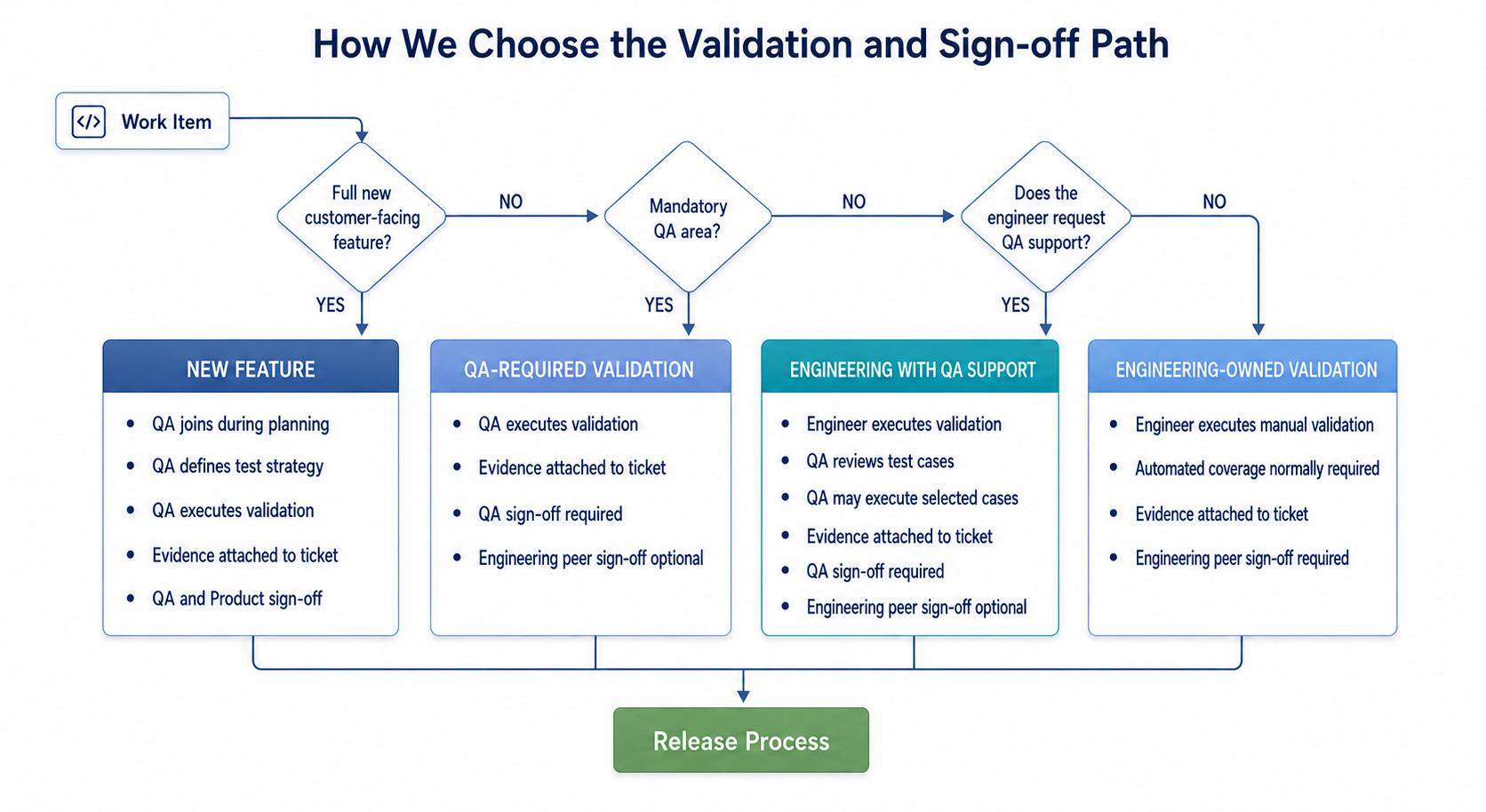
We had to set clear expectations for engineering-owned validation: what evidence to add, which changes needed peer review, and when to involve QA.
We did not change everything at once. Security-related work still requires QA involvement. Feature work still needs a test strategy and test plans. E2E coverage for features remained part of the QE responsibility.
We introduced the process first for bugs, small improvements, and technical issues. This gave teams time to adjust before we expanded it to other work.
Early Results
The first concern was regressions. If engineers validate more work themselves, speed may improve, but quality must remain controlled.
The delivery impact was visible within the first week. Scoped items were usually validated by engineers on the same day they became ready for testing, and the queue disappeared.
Area Result Validation timing Usually same day QA queue for scoped work Disappeared within one week Sprint completion Improved by 12% to 22% Regression rate 2.30% to 2.79% Regression rate increase +0.49 percentage points Bug resolution velocity Increased by 2.28x
We also eliminated endless discussions about which work needed to be tested first. The most important change was the ability to move completed work forward without waiting for a final QA sign-off on lower-risk work.
What We Learned
Changing the reporting structure helped. We moved QA into Engineering and aligned everyone around the same KPIs, SLOs, projects, and delivery goals.
Engineering leads were important during the rollout. Some engineers did not initially consider testing part of their role. Leads reinforced that expectation, and peer review ensured that someone checked both the code and the test evidence.
We also documented the process. Teams needed clear rules for the evidence to add, when another engineer should review it, when to involve QA, and when a ticket could move forward.
What’s Next
The next stage is to make engineering-owned validation easier and more reliable.
One area is agentic validation support. Engineers already share test evidence, but agentic flows can help review those results more consistently, challenge the coverage, and identify missing negative scenarios or edge cases.
The second area is improving how we build test automation. As we learn more from the current rollout, we need to be more intentional about where automated coverage belongs. The goal is not to solve everything with E2E tests. We want to follow the test pyramid more closely and provide teams with clearer guidance on what should be covered by unit, integration, and E2E tests.
This should help us build stronger coverage without making the test suite too slow or too expensive to maintain. It also creates greater overlap across the different layers of testing, so issues can be caught at the right level rather than always being pushed to the end of the flow.
We also want to add selective E2E coverage for reported issues. Not every issue needs a full E2E test, but repeated or high-impact issues should feed back into automation so the same class of problem is easier to catch earlier.
About this work
This post was written by Kevin Bronsdijk, Director of Engineering at Manatal.